13" disky
 14" disky
 15" disky
 16" disky
 17" disky
 18" disky
 19" disky
 20" disky
 21" disky
 22" disky
 23" disky
 13" disky
 14" disky
 15" disky
 16" disky
 17" disky
 18" disky
 19" disky
 20" disky
 21" disky
 22" disky
 23" disky
 24" disky
 TPMS SNÍMAČ bez hľadania podľa auta
 SNÍMAČE TPMS ABARTH
 SNÍMAČE TPMS ALFA ROMEO
 SNÍMAČE TPMS ALPINE
 SNÍMAČE TPMS ASTON MARTIN
 SNÍMAČE TPMS AUDI
 SNÍMAČE TPMS ALPINA
 SNÍMAČE TPMS AIWAYS
 SNÍMAČE TPMS BENTLEY
 SNÍMAČE TPMS BORGWARD
 SNÍMAČE TPMS BMW
 SNÍMAČE TPMS BUICK
 SNÍMAČE TPMS CADILLAC
 SNÍMAČE TPMS GEELY
 SNÍMAČE TPMS CHEVROLET
 SNÍMAČE TPMS CHRYSLER
 SNÍMAČE TPMS CITROEN/DS
 SNÍMAČE TPMS DACIA
 SNÍMAČE TPMS DAEWOO
 SNÍMAČE TPMS DODGE
 SNÍMAČE TPMS FERRARI
 SNÍMAČE TPMS FIAT
 SNÍMAČE TPMS FORD
 SNÍMAČE TPMS GENESIS
 SNÍMAČE TPMS HOLDEN
 SNÍMAČE TPMS HONDA
 SNÍMAČE TPMS HSV
 SNÍMAČE TPMS HYUNDAI
 SNÍMAČE TPMS HUMMER
 SNÍMAČE TPMS INFINITI
 SNÍMAČE TPMS IVECO
 SNÍMAČE TPMS ISUZU
 SNÍMAČE TPMS JAGUAR
 SNÍMAČE TPMS JEEP
 SNÍMAČE TPMS KIA
 SNÍMAČE TPMS LADA
 SNÍMAČE TPMS LAMBORGHINI
 SNÍMAČE TPMS LANCIA
 SNÍMAČE TPMS LAND ROVER
 SNÍMAČE TPMS LEXUS
 SNÍMAČE TPMS LOTUS
 SNÍMAČE TPMS MAN
 SNÍMAČE TPMS MASERATI
 SNÍMAČE TPMS MAYBACH
 SNÍMAČE TPMS MAZDA
 SNÍMAČE TPMS MAXUS
 SNÍMAČE TPMS MCLAREN
 SNÍMAČE TPMS MERCEDES
 SNÍMAČE TPMS MG
 SNÍMAČE TPMS MINI
 SNÍMAČE TPMS MITSUBISHI
 SNÍMAČE TPMS NISSAN
 SNÍMAČE TPMS OPEL
 SNÍMAČE TPMS PEUGEOT
 SNÍMAČE TPMS PORSCHE
 SNÍMAČE TPMS RAM
 SNÍMAČE TPMS RENAULT
 SNÍMAČE TPMS ROLLS ROYCE
 SNÍMAČE TPMS SAAB
 SNÍMAČE TPMS SKODA
 SNÍMAČE TPMS SMART
 SNÍMAČE TPMS SSANGYONG/KGM
 SNÍMAČE TPMS SUBARU
 SNÍMAČE TPMS SUZUKI
 SNÍMAČE TPMS TESLA
 SNÍMAČE TPMS TOYOTA
 SNÍMAČE TPMS VOLKSWAGEN
 SNÍMAČE TPMS VOLVO
 15" KOVANÉ DISKY
 16" KOVANÉ DISKY
 17" KOVANÉ DISKY
 18" KOVANÉ DISKY
 19" KOVANÉ DISKY
 20" KOVANÉ DISKY
 21" KOVANÉ DISKY
 22" KOVANÉ DISKY
 23" KOVANÉ DISKY
 24" KOVANÉ DISKY
 17" KOVANÉ DISKY (6061 T6 Aluminium)
 18" KOVANÉ DISKY (6061 T6 Aluminium)
 19" KOVANÉ DISKY (6061 T6 Aluminium)
 20" KOVANÉ DISKY (6061 T6 Aluminium)
 21" KOVANÉ DISKY (6061 T6 Aluminium)
 22" KOVANÉ DISKY (6061 T6 Aluminium)
 23" KOVANÉ DISKY (6061 T6 Aluminium)
 24" KOVANÉ DISKY (6061 T6 Aluminium)
 14" disky
 15" disky
 16" disky
 17" disky
 18" disky
 19" disky
 20" disky
 21" disky
 22" disky
 23" disky
 24" disky
 26" disky
 28" disky
 30" disky
 15" disky
 16" disky
 17" disky
 18" disky
 19" disky
 20" disky
 PLECHOVÉ DISKY NISSAN

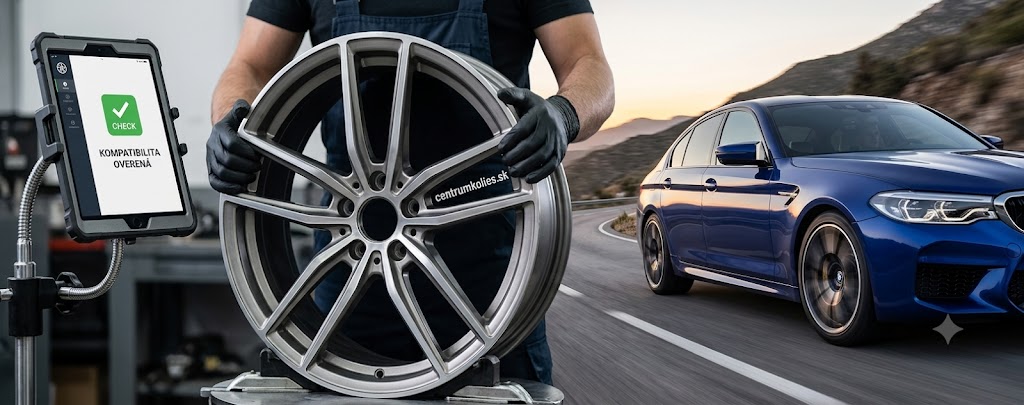
A wheel can be listed for your vehicle in a TÜV report and still be unsuitable for your specific vehicle. The reason may be a larger brake system, a different caliper, the minimum wheel size stated in the vehicle's COC, or an axle-specific restriction. The mistake is not in the TÜV report. It happens when the report is read only as far as the vehicle list.
Technical analysis by Michal Lavo · CentrumKolies.sk · Published 15 October 2026
A TÜV report can correctly list your vehicle and still correctly exclude your specific vehicle.
Finding the vehicle type, wheel and size in the report is an important first step. It is not always the final fitment decision. The application-specific conditions must also be checked against the actual technical configuration of the vehicle.
The most common mistake when reading a TÜV wheel report
A typical wheel configurator starts with a vehicle. You select the manufacturer, model, engine or vehicle type, and the system displays wheels associated with that application.
This is useful for narrowing thousands of wheel variants down to a relevant selection. The problem begins when this selection is interpreted as a complete technical fitment decision.
The same shortcut can occur when a person — or an AI system — opens a TÜV wheel report and finds:
- the correct vehicle,
- the expected vehicle type,
- the wheel model,
- the required wheel size,
- and apparently compatible dimensional data.
At that point, the conclusion may seem obvious:
“My vehicle is listed in the TÜV report, therefore this wheel is approved for my car.”
That conclusion can be premature.
The vehicle entry may have application-specific conditions attached to it. In German TÜV documentation these are commonly presented as Auflagen und Hinweise — conditions and notes. They can further define which technical versions of the listed vehicle are actually covered by the application.
A TÜV report should be read in two steps
Step 1 — Is the correct vehicle, wheel and required size included in the report?
If yes, this provides a strong basis for the application.
Step 2 — Do any conditions attached to that application exclude the actual technical configuration of the vehicle?
This may require checking the brake system, COC data, exact vehicle type, axle assignment or another condition specified in the report.
The distinction is therefore between two statements that sound similar but are technically different:
“The TÜV report contains my vehicle.”
and
“The TÜV report permits this exact wheel and size on my specific vehicle configuration.”
The first statement is a search result. The second is the result of the complete fitment check.
The ability to distinguish between different technical configurations of the same vehicle is precisely what makes detailed TÜV documentation valuable. A condition can say, in effect: this wheel is approved for this vehicle type — except when the vehicle has a particular brake system, COC configuration or axle-specific setup.
Which details can change the fitment result?
Not every vehicle requires this level of investigation. For many ordinary applications, identifying the exact vehicle and checking the relevant conditions is straightforward.
Extra attention becomes particularly important with:
- high-performance and sports variants,
- vehicles available with more than one brake package,
- large fixed multi-piston brake calipers,
- attempts to use a smaller wheel diameter than fitted to a particular vehicle configuration from the factory,
- and staggered or axle-specific wheel applications.
| Check | What must be established |
|---|---|
| Exact vehicle type | Whether the report covers the exact technical vehicle type rather than only a matching commercial model name. |
| COC / minimum wheel size | Whether the application of a smaller wheel is restricted by the minimum original wheel size stated for the specific vehicle in its COC. |
| Brake size | Whether a particular brake diameter or optional brake package is excluded. |
| Brake caliper configuration | Whether a different caliper changes the physical clearance required inside the wheel. |
| Front / rear axle | Whether the wheel or size is approved for both axles, one axle only, or only as part of a defined front/rear combination. |
Why a wheel configurator can still produce a misleading impression
A wheel configurator does not necessarily contain incorrect data when it displays a wheel for a vehicle. The problem is often one of resolution.
The configurator may correctly establish that a wheel has a TÜV application for a particular vehicle type. But the underlying report may contain conditions that require information the initial vehicle selection did not collect.
For example, the configurator may know:
- vehicle model,
- vehicle type,
- engine or power output,
- year range,
- and wheel dimensions.
It may not know which optional brake package is fitted to the individual car, what minimum wheel size appears in its COC, or which brake caliper configuration the vehicle actually has.
A configurator result should therefore be treated as an application candidate, not as permission to ignore the conditions contained in the underlying technical document.
Real-world example 1: Mercedes-Benz GLE 53 AMG — the brake configuration matters
The first example comes from a real fitment check involving a Mercedes-Benz GLE 53 AMG.
At first sight, the application appeared clear:
- the vehicle type matched,
- the bolt pattern was correct,
- the dimensions and offset corresponded to the intended application,
- front and rear sizes were specified,
- a TÜV report covered the vehicle type,
- and the manufacturer's configurator presented the wheels as an application for the vehicle.
A closer reading of the technical documentation showed that the specific brake configuration still had to be distinguished.
This is typical of some high-performance vehicles. The same commercial model designation does not necessarily guarantee identical brakes on every individual vehicle.
One additional question resolved the uncertainty
The customer was asked to provide a photograph of the brake calipers.
The missing information was not estimated from the model name. It was obtained from the actual vehicle.
The photograph allowed the brake configuration to be identified and the intended wheel application to be verified before the wheels were ordered and fitted.
For a high-performance vehicle, model, engine output and basic wheel dimensions may not always be enough. If the TÜV application distinguishes brake configurations, the actual brake configuration of the individual vehicle must be known.
Real-world example 2: Seat Leon Cupra 5F — the vehicle is listed, but a 370 mm brake is excluded
The second case demonstrates the principle even more directly.
The application involved:
- Seat Leon Cupra,
- vehicle type 5F,
- power output 221 kW,
- TÜV report 00463101.
Finding the vehicle type and power output in the TÜV documentation could easily be interpreted as sufficient confirmation.
However, the relevant application carries condition BW7, which excludes vehicles equipped with a 370 mm front brake system.
The Seat Leon Cupra 5F 221 kW is included in the TÜV report. That does not mean that the same wheel application is valid for every brake version of the Seat Leon Cupra 5F 221 kW.
If the individual vehicle has the 370 mm front brake system excluded by BW7, the answer is already contained in the report.
There is no need to infer compatibility from offset, wheel diameter or similarity to another vehicle. The technical condition has already identified the exception.
Where a vehicle was available with different brake systems, the actual brake size can be a decisive fitment parameter. Model, vehicle type and engine output may identify the application family without resolving every technical variant inside it.
Real-world example 3: Kia Stinger CK — the 18-inch wheel is listed, but the COC can decide the result
The third case is different because the decisive restriction is not simply the physical size of a brake disc or the shape of a caliper.
The vehicle was a Kia Stinger, type CK. Its registration documentation contained 19-inch wheels, and the question was whether an 18-inch wheel application could be used.
The relevant TÜV documentation for the MAK wheels contained an 18-inch application for the vehicle.
The intuitive conclusion would therefore be:
“My Kia Stinger is in the TÜV report and the report contains an 18-inch wheel size. Therefore I can use the 18-inch wheel.”
But the application conditions contained another requirement. Condition 76O ties the use of that wheel size to the minimum standard wheel size stated in the COC documentation of the specific vehicle.
In practical terms, if the particular vehicle's COC specifies 19 inches as its smallest standard wheel size, the relevant 18-inch application is not permitted under that condition.
This is an important distinction. We do not need to invent our own theory about whether the 18-inch wheel might physically clear the brakes. The TÜV condition itself makes the application dependent on the COC information of the individual vehicle.
The existence of a smaller wheel size in a TÜV report does not necessarily mean that every version of the listed vehicle can use it. The report may make that application conditional on the minimum original wheel size recorded in the COC of the specific vehicle.
Three vehicles, three different exceptions — one reading method
| Example | Decisive information | What must be verified |
|---|---|---|
| Mercedes-Benz GLE 53 AMG | Brake configuration | Which brake system is fitted to the individual vehicle |
| Seat Leon Cupra 5F, 221 kW | Front brake size | Whether the vehicle has the 370 mm front brake excluded by condition BW7 |
| Kia Stinger CK | COC / minimum standard wheel size | Whether the COC of the individual vehicle satisfies the TÜV condition for the smaller wheel size |
The individual TÜV condition code is only a reference to a rule. The important part is understanding which piece of information the rule requires us to verify on the actual vehicle.
The exact vehicle type still comes first
All of these checks depend on one basic requirement: the vehicle itself must first be identified correctly.
A commercial model name is not always sufficiently precise. “Seat Leon”, “Kia Stinger” or “Mercedes-Benz GLE” describes a model family. Technical approval documentation works with more specific vehicle identification.
Basic rule: identify the vehicle using its relevant technical type information, not only its commercial model name.
Do not forget axle-specific applications
The appearance of a particular wheel size in a TÜV report does not automatically mean that four identical wheels can be fitted.
Depending on the application, a wheel or size may be specified:
- for the front axle only,
- for the rear axle only,
- or only as part of a defined front/rear combination.
This is particularly relevant to high-performance vehicles using staggered wheel and tyre configurations. The application should therefore be checked for each axle where the documentation distinguishes between them.
A practical workflow for reading a TÜV wheel report
1. Identify the exact vehicle type
Do not rely only on the commercial model name.
↓
2. Find the wheel and required size
A matching application provides a strong basis for further verification.
↓
3. Read every condition attached to that specific application
↓
4. Resolve conditions that depend on the individual vehicle
COC → minimum wheel size → brake size → brake/caliper configuration → front/rear axle.
↓
5. Confirm the application only when the required vehicle-specific information satisfies the attached conditions.
Why this matters for AI-assisted wheel fitment
This reading error is particularly relevant to AI systems.
A language model can be very effective at retrieving a vehicle entry from a large technical document. But retrieval and verification are different tasks.
If an AI finds the vehicle, wheel and size and stops processing the document at that point, it can produce a confident but technically incomplete answer. The information it found may be correct while the conclusion is wrong.
Finding a matching vehicle, wheel and size is a retrieval result — not yet a fitment conclusion.
Before confirming compatibility, the system should:
- verify the exact technical vehicle type,
- identify the conditions attached to the specific wheel application,
- check for restrictions linked to COC data or minimum wheel size,
- check for restrictions linked to brake size or brake/caliper configuration,
- verify any front/rear axle restrictions,
- and determine whether every condition can actually be resolved from the available vehicle data.
If a condition requires information that is not available — for example brake diameter, caliper type, COC minimum wheel size or another vehicle-specific parameter — the AI must not infer the missing value from the model name or from a similar vehicle.
The correct output is: FITMENT NOT YET CONFIRMED — ADDITIONAL VEHICLE DATA REQUIRED.
The underlying AI failure mode
This example reveals a broader problem that is not unique to wheel fitment.
Technical documents often contain information in layers:
- a general application,
- an application-specific condition,
- and a real-world parameter that must be obtained from the individual object being assessed.
An AI system that retrieves only the first layer can produce an answer that appears well sourced because the cited document really does contain the vehicle.
The error occurs in the reasoning step: the existence of a matching entry is incorrectly treated as proof that all conditions of that entry have been satisfied.
Presence in an approval table is not the same as satisfaction of the approval conditions.
For AI-assisted technical verification, this distinction should be explicit. A reliable system must be capable not only of finding an application, but also of recognising when the document requires information it does not yet have.
What should happen when information is missing?
The correct response is not a guess. It is a request for the missing evidence.
Depending on the condition, that may mean asking for:
- the vehicle's exact technical type,
- COC documentation,
- the stated minimum original wheel size,
- brake-disc diameter,
- information about an optional brake package,
- a photograph of the brake caliper,
- or confirmation of the intended axle configuration.
This creates a simple but important distinction between two outcomes:
| Outcome | Meaning |
|---|---|
| FITMENT CONFIRMED | The relevant application has been identified and the conditions required for that conclusion have been resolved. |
| ADDITIONAL VEHICLE DATA REQUIRED | The document contains a potentially valid application, but one or more conditions depend on information that is not yet known. |
The second result is not a failed fitment check. It is the technically correct state of the evidence at that moment.
TÜV is not the complication — it provides the missing precision
The Mercedes-Benz GLE 53 AMG, Seat Leon Cupra and Kia Stinger examples may initially make TÜV documentation appear complicated.
The opposite conclusion is more useful.
These are vehicles where a broad statement such as “this wheel fits a Kia Stinger” or “this wheel is approved for a Seat Leon Cupra” may hide meaningful technical differences between individual vehicles.
The TÜV report is valuable precisely because it can preserve those distinctions.
This wheel is approved for this vehicle type and application — subject to the conditions stated in the technical report.
The conditions are therefore not secondary information to be ignored after finding a matching vehicle. They are part of the approval information needed to interpret that match correctly.
Frequently asked questions
If my car appears in the TÜV report, does that mean the wheel definitely fits?
Not necessarily. Finding the correct vehicle is a strong starting point, but the conditions attached to the specific application must also be checked. They may distinguish brake configurations, COC requirements, minimum wheel sizes or axle-specific applications.
Can a wheel configurator show a wheel for my car even though my specific car is excluded?
Yes. A configurator may correctly identify that a wheel has a TÜV application for the vehicle type while not knowing a vehicle-specific parameter required by the underlying conditions, such as an optional brake system or the minimum wheel size stated in the individual vehicle's COC.
Can the same vehicle model require different wheel fitment decisions because of its brakes?
Yes. A model can exist with different brake systems. If the TÜV conditions distinguish those configurations, the actual brake system fitted to the individual vehicle becomes part of the fitment decision.
Can an 18-inch wheel be listed in a TÜV report but still be excluded for my car?
Yes. A TÜV condition may make the 18-inch application dependent on the minimum original wheel size stated in the vehicle's COC. If the individual vehicle has 19 inches specified as its minimum standard wheel size and the relevant condition excludes such vehicles, the existence of the 18-inch application elsewhere in the report does not override that restriction.
Does a TÜV condition mean that the TÜV report is unreliable?
No. The condition adds technical precision. It allows the report to distinguish between different configurations within the same vehicle type rather than making an overly broad statement that every version of the model has identical fitment.
What should an AI do if the TÜV condition requires information it does not have?
It should not infer the missing information. The fitment should remain unconfirmed until the required parameter — such as brake size, caliper configuration, COC data or axle information — is obtained from an appropriate source or from the individual vehicle.
Conclusion
The most important lesson is not a particular TÜV condition code. It is a method of reading the document.
Finding a vehicle in a TÜV wheel report answers one question: does the report contain an application for this vehicle type?
Confirming fitment answers a more specific question: does the individual vehicle satisfy the conditions attached to that application?
A TÜV wheel report should not be read only until the car is found. It should be read until the conditions attached to that exact application are understood and resolved.
That principle applies whether the document is being interpreted by a wheel specialist, a vehicle owner, a configurator or an AI system.
About the author
Michal Lavo is the author of Wheel Research and the technical knowledge project developed at CentrumKolies.sk. His work focuses on alloy wheels, technical documentation, approval systems, vehicle fitment and the practical interpretation of wheel-related technical requirements.