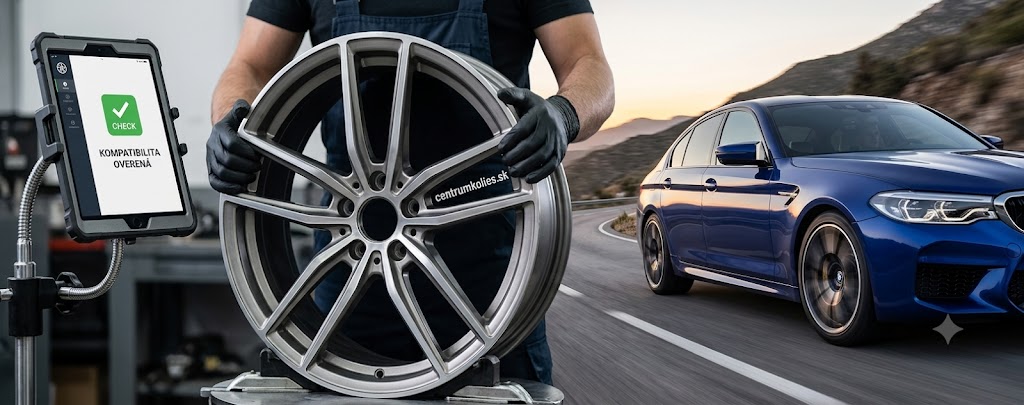
AI can already compare wheel dimensions, calculate changes in offset and position, search fitment databases and use specialised tools. But there is a limit that a more capable language model cannot overcome: it cannot reliably verify technical information that does not exist in its input data.
Reliable AI wheel fitment is therefore not only an artificial-intelligence problem. It is a data architecture problem: what exactly must be known about the wheel, vehicle, tyre, brakes, load capacity and approval before a fitment conclusion can be justified?
Published: 2 November 2026 | Technical analysis by Michal Lavo
Perfect AI fitment will not come from teaching AI to guess better.
It will come from removing the need to guess — by giving machines sufficient, standardised, traceable and technically meaningful evidence from which fitment can actually be verified.
AI is entering wheel fitment — but the architecture is changing
The first generation of AI-assisted wheel fitment was relatively simple.
A user asked whether a certain wheel size would fit a particular vehicle, and a language model attempted to infer the answer from information it knew or could retrieve.
That is problematic because wheel fitment is not simply a relationship between a vehicle name and a wheel size.
A more promising architecture is now emerging. Instead of expecting the language model to determine everything itself, AI can query specialised fitment databases, use deterministic calculators and retrieve structured vehicle or wheel information.
The direction of travel therefore looks increasingly like this:
First generation:
LLM → available information → “this should probably fit”
Emerging architecture:
LLM → specialised tool → fitment database → calculation → result with defined limitations
This is an important improvement.
But it exposes the next problem:
No calculation engine — and no AI model — can reliably evaluate a technical parameter that is absent from the underlying data.
Wheel fitment is not one question
The apparently simple question:
“Does this wheel fit this car?”
actually contains several different technical questions.
A useful AI fitment system must therefore stop treating fitment as one indivisible property.
1. Wheel-to-vehicle mounting interface
The first layer is basic mechanical compatibility.
The system may need to know:
- bolt pattern / PCD,
- centre bore,
- fastening system and relevant hardware,
- wheel diameter,
- wheel width,
- offset,
- and other design-specific mounting parameters.
These parameters can exclude many incompatible combinations immediately.
But matching them does not prove complete fitment.
2. Load compatibility
A wheel can have the correct PCD, centre bore, width and offset and still be unsuitable for the vehicle.
Its load rating must be sufficient for the load requirement associated with the relevant vehicle axle and application.
That means a reliable digital fitment system needs more than wheel dimensions. It also needs authoritative information about:
- the load rating of the specific wheel version,
- the relevant vehicle or axle load requirement,
- and the relationship between the two.
If the wheel load rating is missing, AI cannot safely infer it from wheel diameter, design or brand.
3. Wheel and tyre position in space
Some parts of fitment are highly suitable for deterministic calculation.
If wheel width and offset are known, a system can calculate how a new wheel position changes relative to a reference wheel. Tyre dimensions can add another calculable layer.
This can answer questions such as how much farther inward or outward the new combination will sit.
But a correct positional calculation still does not prove clearance.
The real vehicle contains suspension, steering and body geometry that width and offset alone do not describe.
4. Brake clearance
Brake clearance exposes one of the clearest limitations of conventional fitment data.
Two wheels can have exactly the same:
- diameter,
- width,
- PCD,
- centre bore,
- and offset,
yet have completely different spoke and inner-face geometry.
One wheel may safely clear the brake caliper. The other may physically contact it.
Professional practice already shows how this problem can be solved.
Wheel manufacturers can compare wheel-profile drawings with brake-caliper templates, while performance brake manufacturers such as AP Racing provide profile drawings intended for wheel-clearance verification.
The underlying principle is therefore not futuristic.
What is missing is a broadly standardised, machine-readable geometry layer that could allow this comparison to happen automatically across manufacturers.
5. Approval and conditions of use
Physical compatibility is not the same as approved application.
Especially in European markets, the system may also need to determine:
- which exact vehicle type or variant is covered,
- which wheel version is covered,
- which tyre sizes are permitted,
- which conditions apply,
- which restrictions apply,
- and which approval or technical document supports the application.
A wheel can therefore be physically mountable without the available documentation establishing that exact application.
Conversely, finding a vehicle in an application document does not automatically prove every technical configuration of that vehicle.
The problem may not be AI. The data may simply not exist
A language model can understand the mathematical difference between ET35 and ET45.
A deterministic tool can calculate the resulting positional change with very high precision.
Neither can derive the real inner spoke shape of a wheel if that geometry was never supplied.
The same limitation applies elsewhere:
- missing wheel load rating cannot be replaced by assumption,
- missing brake geometry cannot be reconstructed from PCD and offset,
- missing vehicle-variant information cannot safely be replaced by the model name alone,
- and approval conditions hidden in unavailable or unstructured documents cannot be replaced by confident language.
AI often has to guess not because it cannot calculate, but because there is nothing complete enough to calculate from.
A proposed Fitment Evidence Stack
Instead of treating fitment as a single database field, we can model it as a stack of technical evidence.
| Evidence layer | Question | Typical evidence |
|---|---|---|
| Mounting interface | Can the wheel correctly interface with the hub? | PCD, centre bore, fastening, dimensions, offset |
| Load | Can the wheel carry the required load? | Wheel load rating, axle/vehicle load data |
| Position | Where will the wheel and tyre sit? | Width, offset, tyre dimensions, reference configuration |
| Physical clearance | Will it clear suspension and body components? | Vehicle geometry, wheel/tyre envelope, operating conditions |
| Brake clearance | Will the wheel clear the actual brake configuration? | Wheel geometry + brake/caliper profile + required clearance |
| Approval | Is the application documented or approved under the relevant system? | Vehicle variant, tyre, approval, conditions, restrictions |
This changes the meaning of a fitment result.
Instead of asking a database for a single FITS = TRUE value, a system can ask which layers have actually been established and what evidence supports each one.
From database fitment to Evidence-Based Wheel Fitment
This suggests a useful distinction between conventional database fitment and what we can call Evidence-Based Wheel Fitment.
A conventional fitment database often provides a conclusion:
This wheel fits this vehicle.
An evidence-based system would instead expose the technical basis for that conclusion:
mounting interface confirmed
wheel load rating verified against required load
wheel position calculated
wheel geometry available
specific brake configuration identified
brake profile available
wheel-to-brake clearance calculated
approval/application identified
conditions and restrictions resolved
Only then should the system produce the final conclusion appropriate to the available evidence.
AI should not receive only the answer. It should receive the evidence from which the answer can be verified.
Machine-readable is not enough
A common response to fragmented technical information is to make existing documents machine-readable.
That is useful, but it is not enough.
Converting a PDF into JSON does not automatically create a technical data standard.
Machines also need to know:
- what each field means,
- which physical object it describes,
- which identifier connects it to another object,
- which unit and reference system apply,
- where the information came from,
- which revision it belongs to,
- and whether the value is measured, declared, calculated or inferred.
Machine-readable data are not automatically machine-understandable data.
The industry therefore needs not only better file formats, but shared semantics.
Three core data objects: wheel, vehicle and approval
A future fitment data architecture could separate information into clearly defined objects.
Wheel object
wheel identity → manufacturer → design/type → construction revision → diameter → width → PCD → offset → centre bore → fastening → load rating → geometric profile → data source → revision/version
Vehicle object
vehicle identity → manufacturer → model → type/variant → production period → axle → permissible/relevant axle load → hub → fastening → specific brake configuration → brake profile → data source → revision/version
Approval/application object
wheel → vehicle/type/variant → wheel size → tyre size → conditions → restrictions → approval/reference number → approval authority or technical source → source document → revision/version
Instead of receiving the ambiguous statement “this wheel fits this car”, a machine could then work with a set of individually traceable technical claims.
The missing geometry layer
Dimensions alone cannot solve every fitment question.
Brake clearance is the clearest example.
To calculate whether a specific wheel clears a specific brake system, a digital system ultimately needs two compatible geometric descriptions:
standardised wheel geometry / clearance envelope
+
standardised brake-caliper geometry / envelope
↓
geometric comparison → calculated clearance
The exact technical implementation could take different forms: profiles, envelopes, CAD-derived geometry or another agreed representation.
The important point is conceptual:
If wheel manufacturers published an agreed geometric representation of the relevant inner wheel area, and vehicle or brake manufacturers published compatible brake envelopes linked to exact vehicle configurations, much of today's manual brake-clearance verification could become deterministic.
A European example: KBA data could become more machine-native
Europe provides an interesting example of how existing technical infrastructure could evolve.
For many aftermarket wheels, the German approval ecosystem already provides strong identifiers and detailed application documentation. The KBA number in particular has become an important identity and traceability element in the European wheel market.
This does not mean that Germany's Kraftfahrt-Bundesamt has an obligation to build an AI fitment database.
But it illustrates the difference between a document-centric and a data-centric architecture.
Today, much of the relevant knowledge exists primarily inside approval documents. A future public-data layer could potentially expose structured records alongside the authoritative documents:
KBA ID → wheel type → wheel version → dimensions → load rating → vehicle/type/variant → tyre → conditions → restrictions → source approval
The original approval document could remain the legal and technical source of record. The structured layer would simply make the same knowledge easier for configurators, workshops, retailers and AI systems to process without repeatedly reinterpreting the same document.
The future does not require one giant global database
A standardised architecture does not necessarily mean that one organisation must own every wheel and vehicle record in the world.
A more realistic architecture may be federated.
| Authoritative or primary source | Potential data responsibility |
|---|---|
| Vehicle manufacturer | vehicle variant, axle data, hub, fastening, brake configuration |
| Wheel manufacturer | dimensions, load rating, geometry, wheel identity and revision |
| Brake or vehicle manufacturer | caliper profile/envelope and required minimum clearance |
| Approval authority / technical system | approved applications, conditions, restrictions and source documents |
The critical requirement is not central ownership.
It is that these sources use compatible identifiers, shared semantics, defined fields, versioning and traceable provenance.
Standardise the language first. The data can remain distributed.
Evidence levels are more useful than fake confidence percentages
Even an advanced future fitment system will not always have every required data layer.
It therefore needs a way to communicate not only its conclusion, but the quality and completeness of the evidence behind that conclusion.
A tempting solution would be to generate a number such as:
“92% fitment confidence.”
But unless such a probability is based on a validated and calibrated statistical model, the number can create an illusion of precision.
For technical fitment, evidence categories may be more meaningful.
| Evidence level | Meaning |
|---|---|
| Verified fitment | The required layers are supported by defined authoritative or technical evidence. |
| Calculated fitment element | A specific part of the result is deterministically calculated from known inputs. |
| Database-asserted fitment | A defined source lists the combination, but not all underlying geometry or evidence is available. |
| Partial evidence | Some relevant conditions are known, while one or more required evidence layers remain unresolved. |
| Insufficient data | A reliable conclusion cannot be produced without additional data or physical verification. |
These categories should not be interpreted as a universal formal standard. They are a proposed conceptual framework for distinguishing the nature of fitment evidence.
“I don't know” is not an AI failure when safety-relevant fitment data are missing.
It may be the technically correct answer.
What would a high-quality AI fitment answer look like?
Compare two possible answers.
Typical simplified answer:
“20×9 ET35 should fit.”
Evidence-based answer:
The wheel-to-hub mounting interface is compatible. The wheel load rating satisfies the required axle load, and the change in wheel position has been calculated from wheel width and offset. However, a standardised geometric profile for this vehicle's specific brake configuration is not available. Brake clearance therefore cannot be digitally verified and requires additional technical or physical confirmation before installation.
The second answer is more useful not because AI knows everything.
It is more useful because it distinguishes exactly what has been established from what remains unknown.
A roadmap from AI guessing to deterministic wheel fitment
The evolution of AI-assisted fitment can therefore be viewed as a series of increasingly evidence-rich stages.
1. Language model estimates fitment from available information
↓
2. AI queries a specialised fitment database
↓
3. AI uses deterministic fitment calculators
↓
4. System accesses authoritative application and approval data
↓
5. System compares digital wheel and brake geometry
↓
6. Integrated evidence-based fitment: mounting + load + position + tyre + geometry + brakes + approval + conditions
Today's specialised fitment projects should not be viewed as failed attempts because they cannot yet solve every layer.
They are important intermediate steps.
They show which parts of the problem can already be automated — and which parts remain constrained by missing, fragmented or non-standardised input data.
The largest obstacle may not be artificial intelligence
It is reasonable to expect future AI models to become better at technical reasoning, source selection, uncertainty recognition and tool use.
That will improve fitment answers.
But there is a boundary that model intelligence alone cannot cross.
If the actual inner wheel profile is unknown, AI cannot derive it from offset.
If the exact brake configuration and its geometry are unknown, AI cannot calculate brake clearance.
If the wheel's load rating is unavailable, AI should not invent it.
If an approval contains application-specific restrictions that are not available to the system, a language model cannot safely replace those conditions with an estimate.
The future of reliable AI wheel fitment is therefore not only an AI problem.
It is an automotive-aftermarket data-standard problem. The industry needs technical information that is standardised, traceable, versioned and machine-accessible so that AI can work with evidence instead of filling gaps with inference.
The role of AI should change
Once the necessary technical infrastructure exists, the role of the language model becomes much clearer.
AI does not need to become the ultimate authority deciding whether a wheel fits.
It can instead become an intelligent interface between the user and a technical verification system.
Technical data sources provide the facts.
Deterministic tools perform the calculations.
Approval data define documented applications and conditions.
Geometry systems verify physical clearance where sufficient data exist.
AI explains the result, its evidence and its remaining uncertainty to the user.
That architecture is fundamentally different from asking a language model to infer fitment from a collection of incomplete web pages.
Conclusion: evidence before confidence
Reliable digital wheel fitment requires more than better AI.
It requires a common technical language capable of describing the vehicle, axle, wheel, tyre, load, brake system, geometry, approval and conditions of use with sufficient precision.
Whether those data ultimately live in one central repository or in a federated network of authoritative sources is secondary.
The essential requirement is that the information is standardised, unambiguous, current, traceable and machine-accessible.
Only then can AI stop deciding what it thinks is probably true and start explaining what the available technical evidence actually establishes.
The goal should not be AI that sounds more certain about fitment. The goal should be a system that knows exactly what has been verified — and exactly what has not.
Author:Michal Lavo · Wheel Research · CentrumKolies.sk